Adds as few VSS as possible so that the timetable can be operated. More...
#include <VSSGenTimetableSolver.hpp>
Public Member Functions | |
| ~VSSGenTimetableSolver () override=default | |
| VSSGenTimetableSolver (const instances::GeneralPerformanceOptimizationInstance &instance) | |
| template<typename... Args> requires (!IsSingleInstanceArgument<Args...>::value) | |
| VSSGenTimetableSolver (Args &&... args) | |
| instances::SolVSSGeneralPerformanceOptimizationInstance | solve (const ModelDetailVSSGen &model_detail, const ModelSettingsVSSGen &model_settings={}, const SolverStrategyVSSGen &solver_strategy={}, const SolutionSettingsVSSGen &solution_settings={}, int time_limit=-1, bool debug_input=false, bool overwrite_severity=true) |
| Solves the instance, adding as few VSS borders as possible. | |
| instances::SolVSSGeneralPerformanceOptimizationInstance | solve (int time_limit, bool debug_input, bool overwrite_severity) override |
| S | solve () |
| Solves the problem instance using default configuration. | |
| S | solve (int time_limit, bool debug_input) |
| Solves the problem instance. | |
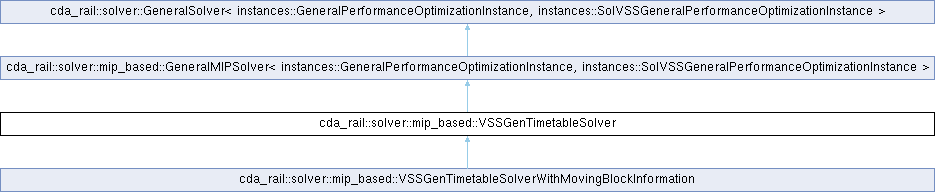
| Public Member Functions inherited from cda_rail::solver::GeneralSolver< instances::GeneralPerformanceOptimizationInstance, instances::SolVSSGeneralPerformanceOptimizationInstance > | |
| const nlohmann::json & | get_solver_data () const |
| The solver data of the last solve, as written to solver_data.json if the solution is exported, so that it can be exported later. Null before the first solve. | |
| const instances::GeneralPerformanceOptimizationInstance & | get_instance () const |
| Accesses the problem instance stored in this solver. | |
| instances::GeneralPerformanceOptimizationInstance & | editable_instance () |
| Provides mutable access to the problem instance. | |
| instances::SolVSSGeneralPerformanceOptimizationInstance | solve () |
| Solves the problem instance using default configuration. | |
| virtual | ~GeneralSolver ()=default |
| Virtual destructor. | |
Protected Member Functions | |
| void | cleanup () override |
| Releases the model and the environment after solving. | |
| void | solve_init_vss_gen_timetable (bool debug_input, bool overwrite_severity) |
| Initializes the logging and the Gurobi model. | |
| Protected Member Functions inherited from cda_rail::solver::mip_based::GeneralMIPSolver< instances::GeneralPerformanceOptimizationInstance, instances::SolVSSGeneralPerformanceOptimizationInstance > | |
| void | solve_init_general_mip (bool debug_input, bool overwrite_severity) |
| Initializes the model with the default message callback. | |
| GeneralMIPSolver ()=default | |
| Constructs a solver with a default-initialized problem instance. | |
| Protected Member Functions inherited from cda_rail::solver::GeneralSolver< instances::GeneralPerformanceOptimizationInstance, instances::SolVSSGeneralPerformanceOptimizationInstance > | |
| void | solve_init_general (bool debug_input, bool overwrite_severity) |
| Initializes logging and records solver start time. | |
| GeneralSolver ()=default | |
| Constructs a solver with a default-initialized problem instance. | |
| nlohmann::json | solver_data (FurtherData const &further_data) const |
| Solver data, i.e., timing and further information (e.g. iterations, nodes, etc.), as written to solver_data.json. | |
| void | export_solver_data (std::filesystem::path const &export_directory, FurtherData const &further_data={}) |
| Exports solver data, see solver_data, into solver_data.json. | |
| std::optional< std::filesystem::path > | export_general_solution (instances::SolVSSGeneralPerformanceOptimizationInstance &solution, const GeneralSolutionSettings &solution_settings, FurtherData const &further_data={}) |
| Exports the solution together with the solver data if requested. | |
Friends | |
| class | VSSGenTimetableSolverWithMovingBlockInformation |
Additional Inherited Members | |
| Protected Attributes inherited from cda_rail::solver::mip_based::GeneralMIPSolver< instances::GeneralPerformanceOptimizationInstance, instances::SolVSSGeneralPerformanceOptimizationInstance > | |
| std::vector< GRBTempConstr > | m_lazy_constraints |
| std::optional< GRBEnv > | m_env |
| std::optional< GRBModel > | m_model |
| std::unordered_map< std::string, MultiArray< GRBVar > > | m_vars |
| GRBLinExpr | m_objective_expr |
| Protected Attributes inherited from cda_rail::solver::GeneralSolver< instances::GeneralPerformanceOptimizationInstance, instances::SolVSSGeneralPerformanceOptimizationInstance > | |
| instances::GeneralPerformanceOptimizationInstance | m_instance |
| decltype(std::chrono::high_resolution_clock::now()) | m_start |
| decltype(std::chrono::high_resolution_clock::now()) | m_model_created |
| decltype(std::chrono::high_resolution_clock::now()) | m_model_solved |
| int64_t | m_create_time |
| int64_t | m_solve_time |
| nlohmann::json | m_solver_data |
Detailed Description
Adds as few VSS as possible so that the timetable can be operated.
The model is time-discretized: for every train and every time step it is decided where the train is, and the VSS borders have to separate every two trains that are on the same TTD section at the same time. In contrast to the moving block problem, the timetable is operated exactly as specified, so that the number of VSS borders is the only thing being minimized.
Constructor & Destructor Documentation
◆ ~VSSGenTimetableSolver()
|
overridedefault |
◆ VSSGenTimetableSolver() [1/2]
|
inlineexplicit |
◆ VSSGenTimetableSolver() [2/2]
requires (!IsSingleInstanceArgument<Args...>::value)
|
inlineexplicit |
Member Function Documentation
◆ cleanup()
|
overrideprotectedvirtual |
Releases the model and the environment after solving.
Reimplemented from cda_rail::solver::mip_based::GeneralMIPSolver< instances::GeneralPerformanceOptimizationInstance, instances::SolVSSGeneralPerformanceOptimizationInstance >.
Reimplemented in cda_rail::solver::mip_based::VSSGenTimetableSolverWithMovingBlockInformation.
◆ solve() [1/4]
|
inlinenodiscard |
Solves the problem instance using default configuration.
- Returns
- S The solution.
◆ solve() [2/4]
|
nodiscard |
Solves the instance, adding as few VSS borders as possible.
- Parameters
-
model_detail How accurately the operation is modelled. model_settings How the VSS borders and braking curves are modelled. solver_strategy How the model is solved. solution_settings Where and what is exported. time_limit Time limit in seconds. No limit if negative. debug_input If true, (more detailed) debug output is printed. overwrite_severity If true, the severity of the log is overwritten even if this decreases the logging level.
- Returns
- Solution object containing status, objective value, and solution.
◆ solve() [3/4]
|
inlinenodiscard |
Solves the problem instance.
- Parameters
-
time_limit Maximum time allowed for solving. Zero or negative values disable the limit. debug_input Whether to enable debug input mode.
- Returns
- S The computed solution.
◆ solve() [4/4]
|
inlinenodiscardoverride |
◆ solve_init_vss_gen_timetable()
|
inlineprotected |
Initializes the logging and the Gurobi model.
Friends And Related Symbol Documentation
◆ VSSGenTimetableSolverWithMovingBlockInformation
|
friend |
The documentation for this class was generated from the following files:
- include/solver/mip-based/VSSGenTimetableSolver.hpp
- src/solver/mip-based/VSSGenTimetableSolver_fixedRoutes.cpp
- src/solver/mip-based/VSSGenTimetableSolver_freeRoutes.cpp
- src/solver/mip-based/VSSGenTimetableSolver_general.cpp
- src/solver/mip-based/VSSGenTimetableSolver_helper.cpp
Generated by
 1.15.0